They're a bit late, but Android tablets with quad-core processors are coming this year, according to Jen-Hsun Huang, Nvidia's chief executive. The chipmaker expects Android tablets supercharged with quad-core chips to hit shelves in time for Christmas, according to a Wall Street Journal report, but smartphones powered by these chips are unlikely to show up until next year.
Nvidia's quad-core chips, first announced in February, are meant to be twice as fast the company's Tegra 2 processor, currently found on about two-thirds of Android tablets from Motorola, LG, and Toshiba. The new breed of tablets was supposed to arrive this summer, but Nvidia's chief executive said manufacturers are taking their time "getting the industrial design as wonderful as possible, and some of it is related to tuning and performance."
However, there is another reason why quad-core Android tablets are late to the game. Most Android tablets manufactures are faced with meager sales compared to Apple's iPad. They are already struggling to match the iPad's pricing and battery life while incorporating current dual-core chips; using a more powerful (and probably more expensive and more power-hungry) processor would make achieving their goal even more difficult. Manufacturers have yet to announce any quad-core products.
In the smartphone market, where Android models dominate the iPhone, quad-core processors were supposed to arrive by Christmas of this year, but Huang didn't say whether Nvidia is still on track with that schedule. Qualcomm and Texas Instruments, which make competing chips for smartphones and tablets, expect their quad-core chips to be featured in devices hitting shelves early next year.Huang also revealed that Nvidia's chips would power some Windows 8 tablets and PCs later next year. Microsoft is set to showcase Windows 8 next week, and--according to Huang--the new OS will be able to run applications developed for its Windows Phone 7 OS as well.
Mostly iphone users have few issues while restoring their device to iOS 4.3.3, 4.3.4 and 4.3.5 as they had when iOS 4.3.2 was initially released. The error is that you would not be able to restore/ update to iOS 4.3.3 and if you have changed your system’s host file to Cydia’s SHSH caching server. An Error 3194 pops up:
This error can be fixed by removing Cydia’s SHSH caching server from your host file or using the latest version of TinyUmbrella steps for which are as follows:
Step 1: Download TinyUmbrella for Mac and Window.
Step 2: Select “Advanced” tab and then uncheck the “Set Hosts to Cydia on the Exit” box.
Step 3: Click on ” Apply Changes” and lastly, restart your PC or Mac.
Chronos is taking its note managing act to the iPad. The company released NoteLife HD for iPad, a tablet-sized version of the media-rich note manager that’s been available for iPhone users since late 2009.NoteLife notes can include plain text, rich text, images, PDFs, audio, video, Web archives, and bookmarks. Users can also add category tags, geotags, encryption, and comments to individual notes.
The iPad app also offers a note browsing history, built-in voice recorder, and camera support. There’s also a search feature, and users have the option to rearrange folders and designate favorites. The ultra-organized will be pleased to know that they can even create sub-folders and customize notes by font and color. You can use the app in both portrait and landscape mode, and view notes in list form or in the app’s Cover Flow view, which offers a more visual representation.
The iPad version of NoteLife can synchronize with its iPhone counterpart as well as with Chronos’s Soho Notes application for the Mac. Currently, syncing is only available over Wi-Fi.NoteLife HD is available in the App Store for $10; it runs on iOS 3.2 or later.

Lion's online usage nearly matched that of Mac OS X 10.5, or Leopard, the edition Apple released in October 2007. At the end of August, Leopard's share was 1.2 percent.Mac OS X 10.6, aka Snow Leopard, remained the most widely-used version of Apple's desktop operating system, with an overall share of 3.5 percent, or 57 percent of all Macs.Snow Leopard's share fell by half a percentage point in August as users migrated to Lion.Mac OS X is still dwarfed by Microsoft's Windows, which powers almost 93 percent of all desktops and laptops, said Net Applications. (See also "Running Windows on a Mac: Lion vs Windows 7 Shootout.")
With August's data, Net Applications revamped the way it tracks operating use by separating smartphones and tablets from conventional personal computers, a change the company said was prompted by the rise in mobile browsing.Net Applications calculates operating system usage share with data obtained from more than 160 million unique visitors who browse 40,000 Web sites that the company monitors for clients. More operating system usage data can be found on the company's site.
The IFA 2011 reveals are starting to roll in, and Sony’s been busy sharing the latest additions to its product lines. Joining the company’s Vaio line-up is the new 24″ Vaio L all-in-one, which features both multitouch input and 3D capabilities.

As Sony’s presser notes, the HDMI input turns the 24″ full-HD display on the new Vaio L into an excellent screen for PS3 gaming. Best of all, the input works even if you haven’t booted Windows — so you can hook it up just like a standard television to any device with an HDMI output. The multi-touch display also features Sony’s Edge Access tech, which works a bit like the bezel swipe actions on the BlackBerry PlayBook: just swipe in from the side to reveal commonly-accessed functions. The new model is set to launch in October of this year, but no specific date has been announced yet.
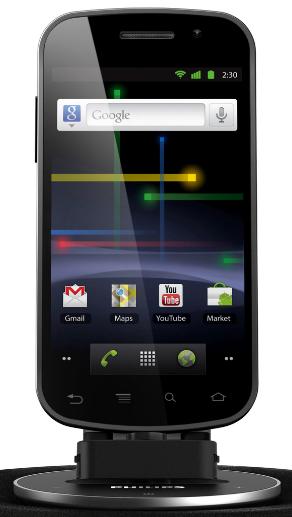
Today at IFA Philips announced the first (nearly universal) audio docks for Android devices. If you have ever taken a trip into a big box retailer, an online retailer, or gone to an electronics trade show you have seen the vast expanse of iPRODUCTS. This product designed to work with Apple iDEVICES blah blah blah. For the past two years I have been waiting for a product similar to this.
Philips addresses the issue that has been holding OEMs from designing for Android – the lack of uniformity. Android comes in all shapes and sizes and very rarely has a manufacturer maintained a design that is uniform even across their own product line. Only recently has Motorola begun to do so with the Photon, Droid 3, Atrix, etc – they should all theoretically be capable of sharing the same docks and accessories.
Philips has designed a unique connector which can be adjusted in three dimensions to offer the ability to hold your phone (or tablet) in either landscape or portrait mode. “This means you can dock and charge most Android phones and your phone will always be positioned at the centre of the speaker for the best sound experience.”
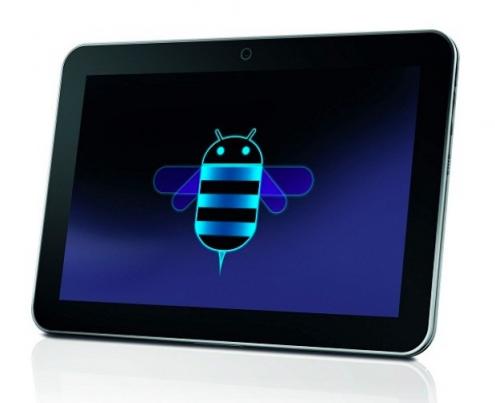
Toshiba's new ultra-thin AT200 tablet is said to be the thinnest, lightest tablet to date.
Just as the rumors predicted, Toshiba has officially announced its next-generation Android tablet, the AT200, which the company boasts is the “world’s thinnest, lightest” tablet PC.The AT200, which will purportedly be called the Excite in the US, was unveiled today the IFA conference in Berlin, Germany. And from what we’ve seen so far, this impressive-looking device could stand as the next major competitor in the Android tablet arena.